

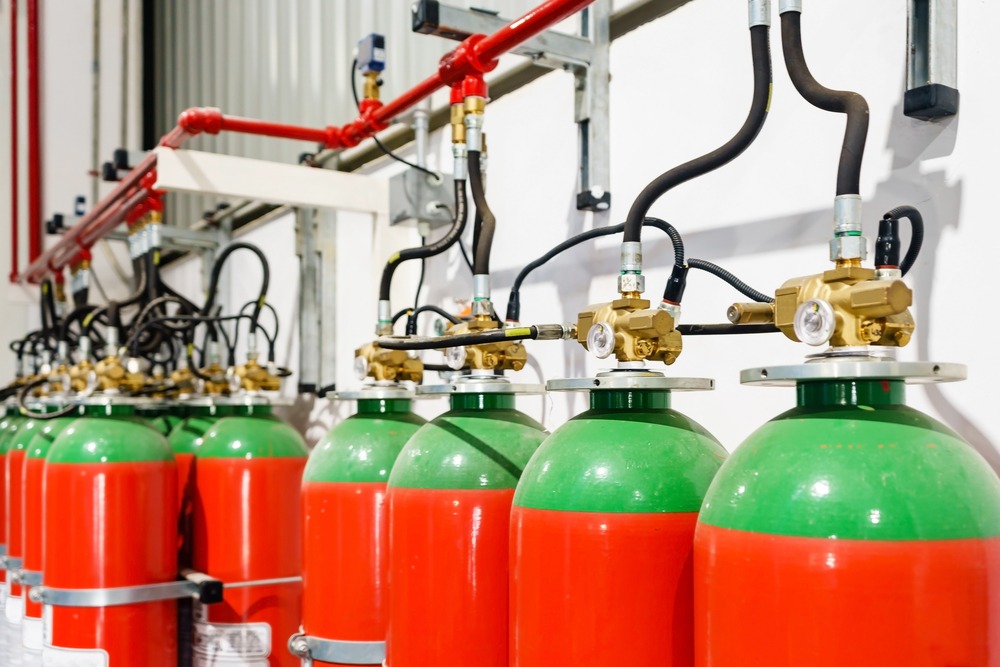

A Gas Suppression system is a waterless fire suppressant that functions by releasing a gas, or mixture of gases, into the air with the aim of extinguishing and/or preventing the fire spread within a building. Gas suppression is a crucial element in a comprehensive fire strategy, especially for protecting high-value assets and ensuring business continuity.
To understand how fire suppression systems achieve this we should first review the principal aspects of fire chemistry. Four components; fuel, oxygen, heat, and the combustion chain reaction are often referred to as the “fire tetrahedron”.
All four of these factors are required in the correct combination for a fire to ignite and sustain burning. The fire tetrahedron shows that a fire can be extinguished by eliminating one or more of the links between these components or by changing the balance between them;
The adoption of high-quality fire suppression technology is vital for UK businesses, particularly given the ongoing threat of commercial fires. While official government statistics for the year ending December 2024 show a decrease in total fires attended by Fire and Rescue Services in England, there were still 38,144 building fires, highlighting that the risk to property and operations remains significant. Protecting specialised areas within these buildings, such as data centres and archives, requires solutions that go beyond traditional methods.
Gas Suppression Systems are sometimes manually activated; however, most are automatic. An automatic system functions through the conjunction of three key elements; a smoke detector, notification device and control panels.
The smoke detectors are the first line of defence and will alert the control panel if smoke is detected within the vicinity. Modern systems often use advanced detection methods like aspirating smoke detection (ASD) systems which continuously sample air and can provide a very early warning, often long before traditional detectors activate. The control panel will then inform the notification device and the piping to begin releasing the gas into the required location. Occupants of the area will be notified by the notification system and made aware that the fire suppressing agent will soon be released. For businesses operating in high-risk sectors like logistics and warehousing, integrating advanced detection with immediate suppression can be the difference between a minor incident and a total loss.
Recent years have seen a strong push towards more environmentally conscious fire safety solutions, impacting the world of gaseous suppression. The industry is constantly innovating to meet stricter global warming potential (GWP) and ozone depletion potential (ODP) requirements, as detailed by bodies like the British Standards Institution (BSI) and the Fire Protection Association (FPA). This shift means that while traditional agents are still effective, newer, ‘cleaner’ agents and inert gas options are becoming the preferred standard for new installations and upgrades. Businesses should be aware of these trends when planning their fire services strategy to ensure future compliance and minimise environmental footprint.
Another major trend is the integration of fire systems into broader smart business solutions. Modern gas suppression systems are increasingly connected, allowing for:
Predictive Maintenance: Sensors within the system can flag potential component failures or pressure drops before they lead to an operational fault, enhancing system reliability.
Remote Monitoring: Facilities managers can receive real-time alerts and check the system status remotely, drastically improving response times. This capability is critical for environments like remote utilities infrastructure or unmanned server rooms.
Building Management Integration: The suppression system can communicate with HVAC (heating, ventilation, and air conditioning) systems, automatically shutting down ventilation upon detection to ensure the gas concentration is retained, a key factor covered in our guide on what is predictive maintenance in fire safety systems and how it works.
These technological enhancements ensure the system is not just a passive extinguisher, but an active, intelligent component of a building’s overall safety and operational network.

The type of gas suppression system used is dependent on a variety of factors such as; storage space for cylinders, installation of pipework, environmental impact, cost etc. Always consult a professional when deciding upon which gas is right for you.
However, here are the three most commonly used gas agents for comparison.
| Novec 1230 | Inert Gas | FM-200 | |
| Type of Compound | A fluorinated ketone contained carbon, fluorine and oxygen. | A mixture of the inert gases: argon, nitrogen, carbon dioxide (CO~2~). | A hydrofluorocarbon (HFC) compound containing hydrogen, fluorine and carbon. |
| Storage | Stored as a liquid | Stored as a gas | Stored as a liquified compressed gas. |
| Discharge Time | 10 seconds | 60 seconds | 10 seconds |
| Clean Up | None | None | None |

Gas suppression is ideally suited in an area where other forms of firefighting may cause water damage to electrical goods.
For example, a server room where data is stored would benefit from a gas suppression system to protect as much of the data as is possible in the event of a fire. Protecting IT infrastructure is paramount, and considering the growing threat of data loss, many businesses in the office sector are upgrading their fire protection to include these waterless solutions.
Furthermore, electrical rooms occupied by employees cannot be fought with traditional firefighting methods as the combination of electricals and water would pose a risk to life.
In addition to technology-rich environments, gas suppression is the preferred method for spaces housing irreplaceable, sensitive, or high-value materials. This includes museum archives, specialist manufacturing facilities, laboratories, and vital control rooms, such as those found in the healthcare sector. In these environments, the cost of downtime and asset replacement far exceeds the investment in a bespoke suppression system. The financial benefits of rapid business recovery after an incident are clear, often resulting in reduced commercial insurance premiums, a topic we explore in depth in our article on how fire safety impacts your commercial insurance premiums. Choosing a certified system that aligns with British and European standards, such as those covered in our guide on security system certification and what insurers look for, is also essential for maintaining coverage.
Conducting a Fire Risk Assessment will reveal if a Gas Suppression System is necessary for your premises, always refer to the RRO 2005 when conducting an FRA.
All gas suppression systems should be tested in accordance with BS 5430-1:1990 where high-pressure cylinders are utilised.
The system should be designed in accordance to the standards BS EN 15004-1 which cover the design, installation and maintenance of the system and guidance on room integrity testing that ensures the areas protected by these systems are capable of retaining the gas on discharge for ten minutes (twenty if the agent involves carbon dioxide). This standard is essential for compliance and ensuring system effectiveness, aligning with the International Organisation for Standardisation’s (ISO) work on clean agent fire extinguishing systems. Businesses can find more comprehensive guidance on fire detection systems and compliance in our blog on how to choose the right fire detection system for your business.
Testing by BRE, FSSA and others has determined that all suppression systems create over pressurisation upon system discharge. Chemical gases (i.e. FM-200, NOVEC 1230 etc.) create under and over pressurisation upon system discharge. To protect against possible structural damage, it is recommended to install a pressure relief vent that discharges to fresh air. This is a critical consideration during the design phase, particularly for protected enclosures in sectors like factory and manufacturing where structural integrity is key.
In protected enclosures means for prompt natural or forced-draft ventilation of areas after any system discharge should be provided, to safely remove fire by-products and extinguishant (as per EN 15004-1 and ISO 14520-1). Forced draft ventilation will often be necessary. Care should be taken to completely dissipate hazardous atmospheres and not just move them to other locations. It should be noted that most extinguishing agents are heavier than air. This step is vital for ensuring the safety of personnel returning to the area, as discussed in the Health and Safety Executive’s (HSE) guidance on active and passive fire protection measures.
If you would like advice or one of our experts to conduct a free on-site survey, please contact us or apply for a free quote. Alternatively visit our Gas Fire Suppression page to find out more about our services.


