


Video analytics play an important role within a business’ CCTV system. A valuable piece of software, video analytics can maximise the potential of your CCTV system and provide other benefits such as a reduced workload for your security team, delivering overall, improved security. Understanding the full capability of this technology is key to deciding on the right solution for your business, and our insights can help you when choosing a CCTV system for your business, from initial design through to full system installation. But what exactly is video analytics, how do they work and what can they be used for?
Video analytics is a type of software used to improve the effectiveness and efficiency of CCTV and video surveillance. Those in charge of surveying the security footage of a business have hours and hours of footage to monitor, in order to capture a particular incident, whether that be a break-in, intruder, or identification of a specific individual.
However, constantly manually viewing footage is not an effective method of security surveillance, due to many factors of being human that we can’t control. For example, a lack of focus over time, tiredness and general human error. It is quite possible that an incident could be missed!
Video analytics, therefore, help to automatically identify these incidents and send an instant alert or notification to the security team so that they can take relevant action.
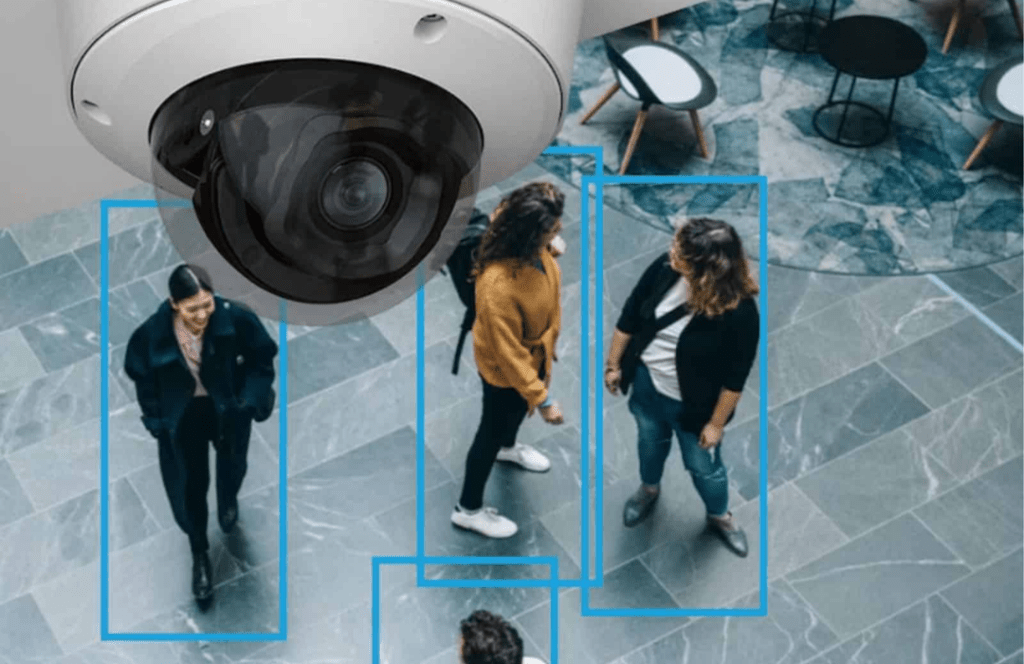
Video analytics has the technology to process video footage using a specific algorithm to carry out an action, in particular, a security-related one. Video analytics software will therefore monitor your CCTV camera footage to search for your chosen type of activity. Once identified, the software will send your security team an instant alert so that they can carry out the necessary actions.
There are various ways in which you can implement video analytics in CCTV, such as installed on the cameras, on your network video recorder (NVR), or as an external 3rd party software. All forms will provide the same ‘monitor, search & alert’ technology but each solution will vary in capabilities depending on the manufacturer and type of application you choose.
Wondering how the video analytics software will identify activity? When setting up your software, you’ll need to set parameters, so that the system knows what it is looking for, as well as the alert notification process. This is so that the video analytics will look for the right type of activity on your CCTV footage and when it finds it, actions the alert response you want.
For example, you may want to set up motion detection on-site during out-of-hours, thus identifying a potential intruder and break-in. If the video analytics detects any motion, your chosen key holder will receive a phone call so that they can react quickly to the incident and call the relevant authorities.
The transition to video analytics marks a significant evolution in the security industry, moving away from purely reactive surveillance—reviewing footage after an event—to a more proactive, preventative model. The global video surveillance market is projected to grow significantly, with one industry report forecasting a compound annual growth rate (CAGR) of over 12% between 2025 and 2030, driven largely by the integration of Artificial Intelligence (AI) and deep learning into these systems. This technological pivot is essential given the growing threat landscape for businesses.
Modern video analytics dramatically enhances detection capabilities and—critically—significantly cuts down on costly false alarms. This is more important than ever as the Office for National Statistics reported a notable rise in crimes targeting businesses, with the robbery of business property increasing by 50% in the year ending March 2025. By combining your analytical software with professional connected managed services, the constant burden of monitoring can be lifted, ensuring real-time alerts are handled by trained professionals who can verify threats instantly, enabling a faster and more effective response.
Video analytics has a vast array of capabilities and can be used to identify many different situations on your CCTV footage, across multiple industries. These include:
Use video analytics to identify specific people of interest or those who are known to the security team. Whether you don’t want them entering your site or want to identify anyone who is within the workplace, that shouldn’t be.
Identify intruders and break-ins by setting up motion detection on your video analytics. Any movement within key areas or during non-working hours will action an alert, enabling quick intervention to prevent loss. When integrating this feature, it’s vital to consider the appropriate security standards, such as those covered in the EN50131 guide to intruder alarm grades, and to ensure your staff are aware of intruder response procedures.
Similar to facial recognition, video analytics can be set up to look for certain vehicle registrations or alert you if there is one it doesn’t recognise. This is invaluable for managing access control in logistics and high-security sites.
Video analytics can be used for crowd management, by counting individuals as well as vehicles, so that you are alerted if there are too many people in one area. Similarly, parameters to search for fights and brawls can also be set up, which is especially useful in large social settings. Crowd management analytics are also crucial for maintaining health and safety compliance, and they provide key business intelligence for sectors like retail, allowing businesses to optimise store layouts based on footfall data.
Use video analytics to alert you if there are too many customers waiting at a checkout point. Provide better customer service as well as keeping your customers safe.
Identify a potentially big security issue by setting a parameter for unattended baggage. Be alerted instantly for suspicious items of luggage with video analytics. Utilising this capability is a core benefit of adopting remote monitoring for your security systems.
Video analytics can also be used to identify the signs of a fire breaking out. Working alongside your fire safety system, using fire detection with video analytics is a clear way to secure maximum protection against the devastating effects of fire, by identifying it quickly and early. This is a critical feature, especially as official statistics from the UK government show that false fire alarms due to apparatus are a growing problem, reaching 179,735 in the year ending December 2024. Integrating video verification with your fire alarm monitoring allows operators to quickly verify an alarm before mobilising the Fire and Rescue Service, saving valuable time and public resources.
You can read more about this in our article on the future of fire detection sensors, IoT, and real-time analytics.
Beyond traditional security threats, advanced analytics can monitor dwell time—the length of time a person stays in a designated area. This can be used to identify loitering or suspicious behaviour around entry points or valuable assets, enabling a proactive intervention before an incident occurs. In retail, dwell time analysis helps measure the effectiveness of product displays and promotions.

Video analytics are therefore an integral part of a CCTV system and ensure maximum security to your business, employees and visitors, as well as providing other added benefits that can improve other aspects of your business such as efficiency and customer service. Embracing video analytics is a clear step towards fully leveraging the role of CCTV in enhancing business security today.
At BusinessWatch, we provide full CCTV system installation and video analytics software to ensure the safety and security of your business. Get in touch today for a free, no-obligation quote on 0330 094 7404.


