


CCTV systems have become an integral part of modern security measures, with recent 2026 estimates suggesting there are approximately 6 million cameras in the UK, offering peace of mind to homeowners, businesses, and property managers. However, if you’ve noticed a CCTV camera pointing directly at your property, you may have concerns about privacy and whether this is legally allowed in the UK. The question many homeowners have is: can my neighbour have CCTV pointing at my house?
This issue raises important questions about privacy, personal rights, and the legal boundaries of surveillance. In this blog, we will explore the regulations surrounding CCTV use in residential settings, what your rights are as a homeowner, and how to handle situations where your neighbour’s CCTV may infringe on your privacy. We’ll also look at the types of CCTV services BusinessWatch offers for commercial and residential properties managed by property companies, ensuring proper surveillance while respecting privacy.
In the UK, the use of CCTV is regulated by various laws and guidelines to protect individuals’ privacy. The main laws that govern CCTV use in both public and private spaces include the Data Protection Act 2018 (DPA) and the General Data Protection Regulation (GDPR). These laws apply not only to businesses but also to individuals using CCTV in private residences or residential areas. It is also important to note that the Data (Use and Access) Act 2025 has further refined how data controllers must manage footage, emphasising transparency and the specific justification for every camera’s field of vision.
Under the GDPR, CCTV footage is considered personal data because it can identify individuals. This means that anyone who installs a CCTV system, whether it’s a neighbour or a business, must ensure that they comply with data protection principles when recording footage. These principles include:
In the case of residential properties, if your neighbour’s CCTV camera is capturing footage of your home or garden, this may be seen as an intrusion into your private space. Under these regulations, individuals who are recording others’ images must respect their privacy rights. This is especially relevant when considering what are the regulations for CCTV in the UK, as homeowners can technically become data controllers the moment their cameras look beyond their own property boundary.
The Human Rights Act 1998 enshrines the right to privacy, as outlined in Article 8 of the European Convention on Human Rights (ECHR). This article protects individuals against unlawful interference with their privacy, family, home, or correspondence. If a neighbour’s CCTV system is capturing footage of your property, this could potentially breach your right to privacy.
However, there are exceptions. CCTV systems installed for legitimate purposes, such as protecting property or preventing crime, may be allowed, provided the surveillance does not infringe on the privacy rights of others. For instance, a camera focused on a shared driveway or a public pathway may be acceptable, but a camera that captures private areas of your home or garden without a legitimate reason could be considered a violation of your privacy. Many property management firms now use digital privacy masking to ensure that while common areas are secured, individual windows remain blurred to maintain compliance.

Not all CCTV use is automatically a violation of privacy. In fact, CCTV can be perfectly legal when used for specific purposes, such as:
If your neighbour’s CCTV is installed to monitor and deter criminal activity in the area, such as protecting property or preventing break-ins, this may be deemed a legitimate reason. This is a common strategy in high-traffic environments like retail locations where security is paramount.
If the camera is pointing at a public area, such as the street or shared garden space, it may be less of a privacy concern. Surveillance in public areas is generally seen as acceptable as long as it adheres to data protection laws. Many businesses use this to understand is it legal to watch your staff constantly on CCTV, concluding that while public-facing security is fine, internal monitoring must be strictly justified.
A CCTV camera must not be disproportionately focused on private areas of your property. For example, it would be reasonable for your neighbour to have a camera pointing at their own driveway or front door but not directly into your windows or garden. The Information Commissioner’s Office (ICO) suggests that owners should always attempt to point cameras away from neighbours’ properties to avoid becoming a data controller.
The key here is proportionality – the camera should be positioned in a way that it captures only what’s necessary to achieve its intended purpose, without infringing on your privacy. Ensuring you understand can my neighbour have CCTV pointing at my house in the UK is the first step in protecting your domestic boundaries.

If you feel that your neighbour’s CCTV system is unlawfully intruding on your privacy, there are several steps you can take:
Start by having a conversation with your neighbour. They may not be aware that their CCTV camera is pointing at your property. Politely ask them to reposition the camera so that it no longer encroaches on your private space. You might also ask if they are using video analytics software that allows for digital masking, which can block out your property without moving the physical camera.
If the camera is focused on private areas of your home or garden (such as through windows or into your garden), this may be a breach of privacy. You can point this out in your discussion and ask them to reposition the camera to focus only on their own property. This is a common issue in various environments, including the healthcare sector, where patient privacy is protected by strict surveillance zoning.
If you believe the CCTV system is capturing personal data without a legitimate purpose, you can raise this with the Information Commissioner’s Office (ICO). The ICO oversees data protection and can investigate whether the surveillance is in compliance with the law.
In extreme cases, if discussions with your neighbour don’t resolve the issue, you may want to seek legal advice. Depending on the situation, you may have grounds to file a complaint or take legal action for breach of privacy. Professionals in office management and larger residential blocks often have to manage these disputes through formal legal frameworks.
If direct communication doesn’t work, you may consider mediation services, where a neutral third party can help resolve the dispute. This is often more cost-effective than taking the matter to court and helps maintain long-term neighbourly relations.
The GDPR requires CCTV owners to be transparent about the use of surveillance. While there is no explicit requirement for individuals to notify their neighbours, it’s a good practice for anyone with a CCTV system to display a sign informing others that they are being recorded. This mirrors the best practices seen in logistics hubs and warehouses where clear signage is a legal necessity.
If you notice a CCTV camera pointing at your property and are unsure if your neighbour has properly informed you about it, you can request more information about the purpose of the surveillance and whether they have considered the privacy implications. For further clarity, you may want to read about GDPR and CCTV to understand the depth of these obligations.
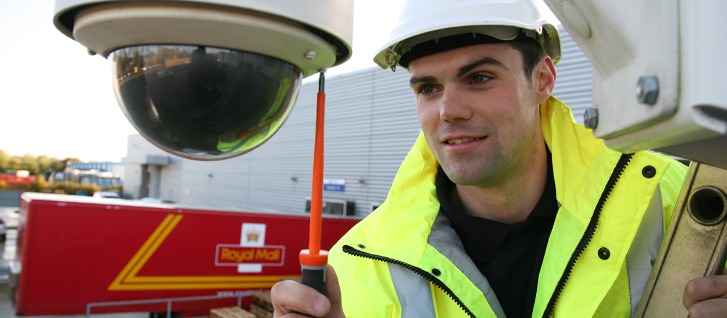
While BusinessWatch primarily focuses on commercial CCTV installation, monitoring, and maintenance for businesses and property management companies, we understand the importance of privacy compliance for all types of properties, including residential ones.
For property management companies, housing associations, and businesses overseeing residential properties, BusinessWatch offers CCTV solutions that provide high-quality surveillance while adhering to data protection laws. Our team ensures that systems are installed with privacy in mind, positioning cameras to monitor only public or high-risk areas and avoid infringing on residents’ private spaces. We offer a variety of business security packages that cater to different compliance needs and budgets, ensuring your surveillance is both effective and lawful.
For more information on how we can help you with CCTV solutions for your commercial or residential properties, get in touch or call us on 0330 094 7404 for a free quote today.


