Most of us take the presence of fire safety signs for granted. But whilst we may not pay attention to them on a typical day, in a real emergency they can be the difference between life and death. That’s exactly why they are a crucial element of any businesses’ fire safety strategy. Read our full guide to categories of fire signage and fire safety signs to discover why they’re so important, if your business is required to use signage by law, what the various categories of fire signage are, as well as what each sign really means.
In the year ending December 2024, Fire and Rescue Services (FRSs) in England attended over 136,700 fires, demonstrating the persistent risk that businesses face, according to the latest UK government fire and rescue incident statistics. While the total number of fires is on a declining trend, the reality is that any incident can have devastating consequences for life and property. For instance, workplace fires in 2023/24 were approximately 7,000, with faulty electrical equipment being a leading cause. This highlights that a robust fire safety strategy, which includes clear and compliant signage, is a non-negotiable part of business operations, whether you manage a large office, a busy retail space, or a complex logistics facility.
It’s vital that everyone in a building is aware of their nearest fire exit, escape routes and where to find fire fighting equipment. Fire signage is essential in guiding the occupants of your business premises when a fire breaks out. If employees and visitors don’t know where their nearest fire escape and equipment is located, they could be susceptible to serious harm. Signage works in tandem with systems like fire alarms, and is particularly critical when visibility is low or panic sets in, providing an immediate and universally understood direction to safety. The clearer the path, the faster the evacuation, which is why having an effective system is so crucial for business security and continuity.
Your business must be compliant with the Regulatory Reform (Fire Safety) Order 2005 (often referred to as RRO). This life saving legislation, set out by the UK government, brings together all of the fire safety laws and safety regulations for businesses in the UK.
The RRO states that fire signage must be fitted at all business premises to help prevent and fight fires. Since the introduction of the Building Safety Act 2022, the requirements placed on Responsible Persons (RPs) have been significantly strengthened, mandating that all fire safety arrangements, including the location of fire safety signage, must be properly documented and recorded, regardless of the size of the business or the number of employees. Furthermore, the Fire Safety (England) Regulations 2022 introduced specific rules, particularly for multi-occupied residential buildings, requiring responsible persons to provide residents with information about fire safety matters, which includes how to report a fire and the building’s evacuation strategy. These ongoing legislative changes underscore the need for businesses to keep their fire safety signage up-to-date and compliant, especially when considering the importance of a clear fire escape plan. But what type of signs need to be in place?
The different types of fire safety signs that businesses must have, in accordance with BS 5499-10:2014 (Safety signs. Guidance for the selection and use of safety signs and fire safety notices), include:

Signs that fall into this category include “No Smoking” notices. These messages outline a prohibited action that could increase the risk of a fire, such as prohibiting the use of open flames in high-risk zones, which is vital in factory environments or areas storing flammable materials.
These signs indicate steps people must take to comply with fire regulations, which are designed to safeguard occupants. An example of a mandatory sign is a “fire door keep shut” notice. This simple instruction is key to passive fire protection, helping to prevent the spread of fire and smoke throughout a building. This category is essential for ensuring fire doors, a critical element of passive fire protection, function correctly.
These signs are required to make people aware of the presence of flammable materials. For example, a store cupboard that contains potentially dangerous liquids. They are triangular with a black symbol on a yellow background, immediately alerting personnel to dangers like flammable liquids, corrosive materials, or electrical hazards that could be a potential fire cause, allowing for a proactive response as discussed in our guide to the top 5 fire hazards in the workplace.
 Safe condition signs
These signs indicate fire escape routes, fire assembly points and first aid equipment to guide occupants dealing with an emergency and escaping the building. They must be clearly visible and strategically placed along the entire escape route to ensure a swift and safe evacuation.Fire exit signs – **These signs are required in order to highlight the location of fire exits so those escaping the building quickly know which door to head for. They utilise the ‘running man’ pictogram and directional arrows, and their placement is paramount to meet the standards for safe evacuation in a building.
These notices direct people to the location of fire fighting equipment such as fire extinguishers or fire hoses and also fire alarm activation areas. Depending on the layout of your building, this may not be required if the equipment itself is highly visible. These signs, along with equipment, should be easy to access in an emergency, particularly in high-risk environments like commercial food premises.
To provide further instruction, these signs include information such as a directional arrows or text to expand on neighbouring notices. These are often used in conjunction with safe condition signs to offer specific direction, such as “Fire Exit Downstairs”. The clarity of these signs can be a lifesaver, reinforcing the importance of proper fire safety training for all staff.
The correct choice and positioning of these signs are not just regulatory checks but a critical line of defence. For premises like healthcare facilities or schools, which have a high number of occupants or vulnerable people, the standard must be exceptionally high. Failure to ensure that all necessary fire safety measures, including clear signage and functional systems like emergency lighting, are in place can lead to significant penalties, as the government continues to increase fines for non-compliance with the Fire Safety Order.
Understanding the full spectrum of fire safety signage ensures that your business provides the maximum level of guidance and protection in an emergency, mitigating both risk and liability. Regular checks and maintenance of these signs are essential to ensure they remain legible and correctly positioned, especially as part of broader efforts to improve safety, as outlined in guides like the one on fire safety compliance for landlords.
The fire signage categories listed above have been standardised with different colours and shapes, following international standards (ISO 7010, which the UK largely adheres to). As a result, they can be re
cognised immediately and interpreted quickly in an emergency situation.

Fire safety signs associated with escaping a fire are green, which has become the universal colour for “go” and safe conditions. These types of notices are square or rectangle in shape and have contrasting white writing or pictograms on them. Exit notices may need to be illuminated so that they adhere to fire door signs regulations. Emergency lighting is used to make them visible in varying light conditions, especially during a power failure, ensuring that the escape route is always clear and well-lit.
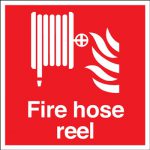
Any fire safety signs that are associated with fire fighting equipment is red. This is in line with the equipment itself, which is also required to be red in colour. The writing and pictograms on these signs are white and they are square or rectangular. One example of this kind of sign is a fire hose notice, which highlights the location of fire fighting equipment. The specific shade of red is internationally recognised to indicate the location of fire-fighting equipment, helping occupants quickly find the necessary tools to tackle a small fire, reinforcing the guidance in our article on regular fire extinguisher inspections.
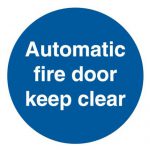 What do blue and white health and safety signs mean?
Blue fire safety signs with white writing on them state mandatory precautions that one must abide by in a building. Mandatory signs are circular in shape. An example of this type of sign includes the familiar “FIRE DOOR KEEP SHUT” notice, designed to offer protection in the event of a fire. These signs are crucial for maintaining the integrity of fire compartments, a key aspect of passive fire protection.

Yellow fire safety signs carry warning messages and are triangular in shape. They feature a black symbol that indicates the type of hazard in a specific area. An example of a yellow warning message is a fire risk sign, often used to indicate the presence of flammable materials or to warn of an electrical hazard that requires immediate attention.
While the design and colour-coding of fire safety signage is standardised, businesses operating across different business sectors must consider the specific needs of their employees and visitors. For instance, in environments with low light or high noise levels, like large logistics warehouses, photoluminescent (glow-in-the-dark) signs are often recommended to ensure visibility even if emergency lighting fails. Furthermore, the positioning of signs must take into account the height and visibility for all occupants, including those with disabilities, in line with modern accessibility standards, as detailed by the Health and Safety Executive (HSE). Regularly reviewing your signage in line with a professional fire risk assessment is the only way to ensure they remain fully compliant and effective for your premises.
| Type of fire safety sign | Colour of sign | Shape of sign | Message | Example signage |
| Mandatory signs that indicate things that SHOULD be done | Blue with white writing or symbols | Circular | Fire door keep shut |  |
| Prohibition signs that warn outline things that SHOULD NOT be done | Red outline with a white background and a red strike through | Circular | No naked flames |  |
| Warning signs that highlight specific fire risks in a building | Yellow with black detail | Triangular | Fire risk |  |
| Safe condition and fire exit signs that highlight escape routes | Green with white writing and symbols | Rectangular | Fire exit this way |  |
| Fire equipment signs that direct people to extinguishers and hoses | Red with white writing and symbols | Circular or rectangular | Fire extinguisher is located here |  |
| Supplementary information signs to provide additional direction | Multiple colours, including green, red or yellow | Rectangular | Escape route |  |
Firstly, it’s imperative that a fire risk assessment is carried out. This will check the following things to ensure that your workplace complies with the RRO:
We always recommend businesses book in for a professional fire risk assessment. This is carried out by our team of fire experts, who are accredited by the Institution of Fire Engineers, who will ensure that your site is compliant with all the laws and regulations. Businesses should also be aware that the competence of the assessor is now a major focus of the Building Safety Act, ensuring that those appointed to manage fire safety are suitably qualified. For more insights on financial responsibilities, you can read about how fire safety impacts commercial insurance premiums.
Contact the fire safety experts at BusinessWatch today for a no-obligation chat about your requirements. We can offer free advice to help your business become RRO compliant. Our knowledgeable team have helped hundreds of UK businesses to reduce the likelihood of fire at their premises and improve the safety of employees. BusinessWatch is a BAFE approved provider of fire safety services.