


Fire is a real, non-negotiable risk for businesses, and effective evacuation during an emergency is critical. Traditional manual sign-in procedures are slow, confusing, and prone to catastrophic errors when every second counts.
This is why the Roll Call Check-In System is an essential part of modern safety. These smart solutions use technology to instantly track personnel and provide emergency managers with immediate, precise information on who is safely out and who remains inside. Keep reading to find out what is a roll call check in system in fire evacuation, its benefits and more.
Fire roll call systems are used to automatically identify the location of all people within a premises with pinpoint, real time accuracy.
This allows you to ensure that all personnel have reached a designated safe area or assembly point in the event of an emergency, or quickly locate them within the premises if they have not. In an environment where the safety of every individual is paramount, investing in robust fire safety systems that mitigate human error is a critical step for any Responsible Person to reduce legal exposure and understand legal responsibility in fire incidents at work.
A roll call check in system can accurately track the location of visitors, personnel and employees as they enter and exit each building on a particular premises. Modern automated roll call systems integrate seamlessly with other building management features, ensuring that compliance requirements are met while enhancing overall security protocols.
This results in much shorter response times in the event of an emergency and allows incidents managers to quickly determine if anyone is still inside a building.
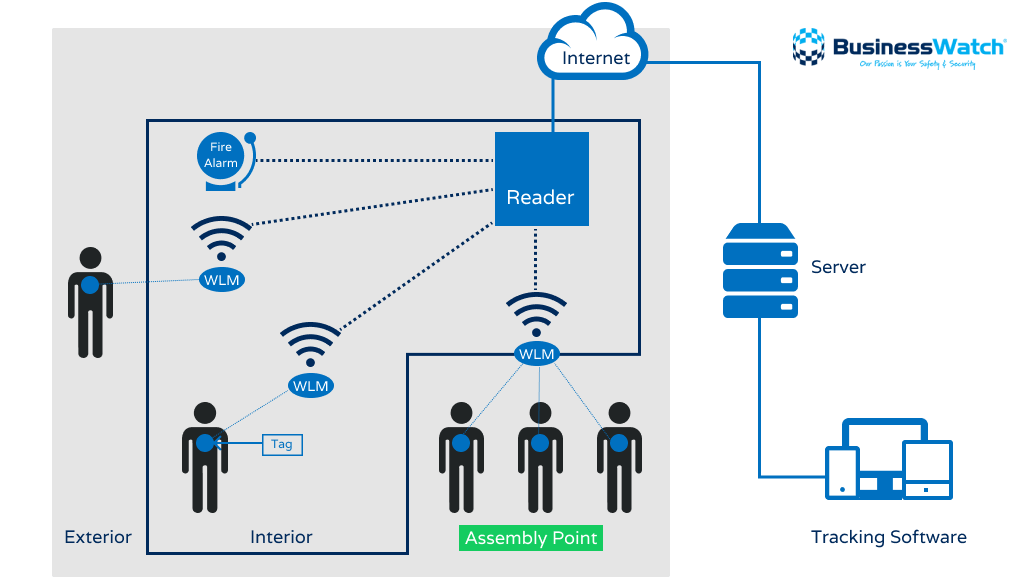
Each employee within a premises will receive a personal RFID tag which transmits a signal every 1.2 seconds. This signal informs a centralised system of the identity of the personnel, as well as their exact location.
Wireless Location Modules or WLMs, detect the RFID tags on personnel as they enter or exit each building. The integration of WLMs into the broader framework of smart safety infrastructure represents a key part of the move toward proactive fire and security management. To learn more about how this technology will evolve, check out our guide on the future of fire detection sensors, IoT, and real-time analytics.
Each WLM is configured to detect RFID tags within a specific read zone which can range from 1 to 80 metres. The ranges of each WLM is catered to suit each individual site.
WLMs are also located at designated safe areas or assembly points so in the event of an emergency, the system can log the presence of all of the personnel. More importantly, with this information incident managers can quickly identify those that are not present.
If an individual is logged as not present, the system will recognise their last known location and display it to an incident manager through a smart device or portable media device.
When a fire alarm is activated, the system automatically has a record of all of the people within the building. It then categorises them as in ‘danger’ until they arrive at a designated safe area.
This information is displayed on said smart device alongside an image of all personnel who still remain ‘at risk’ after the fire alarm is activated.
Automatically accounts for all people on-site:
By employing one of these systems, you will always know where personnel are on your premises. Not only will this help you to protect your assets but will also protect the lives of anybody in your building in the event of an emergency.
Removes the potential for human error
The traditional method of having people sign in and out of buildings leaves room for potential human error. The result of an unlogged individual being stuck in an emergency could be catastrophic.
Quickly identifies people in ‘danger’ and their most recent location
Instantly identifying between those present at a safe area and those that are still at risk, can help prioritise in the event of an emergency and reduce vital response time.
Provides emergency services with vital information in an emergency
Being able to provide the emergency services with both an image of the person ‘at risk’, is well as their last known location can help the fire services act efficiently and may be the deciding factor in protecting lives.
Reduces downtime of evacuation drills
The ability to quickly identify that all of your personnel are safely at an assembly point can reduce the time it takes to perform evacuation drills and therefore improve their efficiency.
Saves time and money
A traditional roll call system would require security at entry and exit points to sign personnel in and out. Reduce these additional costs by automating these logs.
Hosted and operated off and on-site
Having the system operated off site as well as on-site, means if the central system was damaged in the event of an emergency, you would still be able to monitor and provide vital information to emergency services. This remote monitoring capability is key for business continuity, as discussed in our guide on the benefits of remote monitoring for fire and security systems.
Provides ultimate peace of mind to both you and your staff
If staff members know that they can be easily tracked and found in an emergency, this can help to reduce panic if a fire alarm is activated.

Implementing a fire roll call system will help you to boost fire safety considerably. However, whilst extremely useful, it’s important to note that this approach is not 100% effective. There is still room for human error. A fire roll call system should therefore not be solely relied upon in an evacuation procedure.
For example, visitors, managers and engineers on site may not have been issued RFID tags upon entering the premises. Therefore, in the event of an emergency, they would be at risk if no other precautions were taken outside of an automated roll call system.
The landscape of fire safety in the UK has been significantly reshaped by recent legislative changes, particularly amendments to the Regulatory Reform (Fire Safety) Order 2005 (RRFSO) brought in by the Building Safety Act 2022. These changes have increased the statutory obligations on the Responsible Person to document and record fire safety arrangements, and include measures such as the identity of any person appointed to assist with making or reviewing a fire risk assessment, according to the London Fire Brigade. An accurate, recorded roll call system directly supports this compliance requirement by generating an auditable record of who was in the building at the time of activation, crucial for demonstrating due diligence to the Fire and Rescue Service (FRS).
Furthermore, while the total number of fires attended by FRSs in England saw a decrease in the last year, the FRS still attended 251,852 fire false alarms in the same period, with false alarms due to apparatus being the highest figure in the time series, according to official UK government fire and rescue incident statistics. This highlights the ongoing challenge of efficient evacuation management. An accurate roll call system helps differentiate genuine emergencies from false alarms quickly, minimising disruption and preventing ‘evacuation fatigue’ among staff. If you are a property manager or landlord, understanding this compliance is essential, as detailed in our guide on what landlords must know about fire safety compliance in 2025. Businesses seeking professional guidance in navigating these complex legal frameworks can benefit from expert fire safety consultancy.
A full sweep of the premises by allocating zones to each of your fire marshals is likely the most effective means of ensuring a building is fully evacuated. You should also be sure to allow for appropriate holiday and sick cover so there will always be enough marshals on site. For businesses looking to establish robust in-house support for safety, creating fire safety champions is an excellent way to ensure complete coverage.
The best possible system to employ would be to combine both a fire marshal sweep with fire roll call systems. This will allow you to immediately identify people particularly at risk on your smart device, whilst ensuring that no visitors remain within the building through the fire marshal sweep.
The combination of technology and personnel is particularly vital in high-risk environments or premises with complex layouts. For example, in the healthcare sector, where vulnerable people may require assistance during evacuation, pinpointing the last known location of staff and patients saves critical seconds. Similarly, large logistics and warehouse operations often cover vast areas with multiple evacuation routes, making real-time location tracking indispensable for swift and safe incident management.
On a site with 300 plus employees, a combination of these two systems is essential.
If you are looking to introduce a roll call check in system for your business or would like further advice, please apply for a free quote or contact us. Alternatively, visit our Roll Call Systems page to find out more about this service.


