

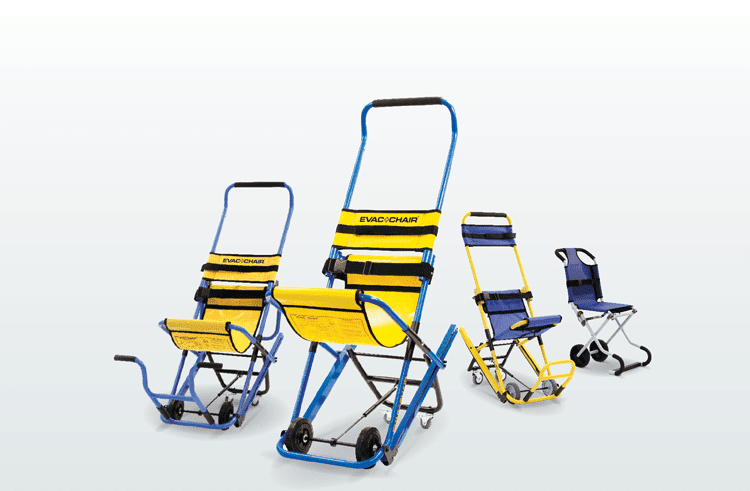
What is an Evacuation Chair?
Evacuation chairs provide an efficient, safe and comfortable means of evacuating an individual that is mobility-impaired in the event of an emergency, such as a fire.
You may also see evacuation chairs being referred to as; stairway evacuation chairs, fire evacuation chairs, evacuation chairs or disabled evacuation chairs.
An Evacuation chair can aid a diverse range of people that cannot evacuate a building without some assistance. An individual may be incapable of evacuating without assistance due to injury, disability, pregnancy and many other medical conditions that can hinder their ability to move quickly in an emergency. This is particularly relevant in multi-story premises across sectors like healthcare and office environments where a quick, safe descent is critical.

There is currently no explicit legal requirement for an organisation to provide evacuation chairs, but the requirement to ensure safe evacuation is absolute. The most relevant piece of legislation is the Regulatory Reform (Fire Safety) Order 2005 or RRO 2005.
Within the RRO, it states that, after revising the findings of a fire risk assessment, the ‘responsible person’ on the premises must ‘consider anybody who may be especially at risk’ and act to protect these individuals as best they can. For example, somebody with a physical disability. This is further reinforced by the Equality Act 2010, which mandates that employers must make ‘reasonable adjustments’ for disabled staff, visitors, and customers. In a multi-storey building where a lift cannot be used during a fire, providing an assisted means of escape, such as an evacuation chair, is often deemed a reasonable and necessary adjustment to fulfil these legal duties. Ignoring this duty could expose the business to significant risk, as explored in detail in our article on understanding legal responsibility in fire incidents at work.
Therefore, government guidelines concur that where evacuation chairs are the preferred method of escape, the responsible person on the premises will provide them.
The provision of an evacuation chair is an integral part of a compliant Personal Emergency Evacuation Plan (PEEP). A PEEP is a bespoke, written plan for an individual who requires assistance to evacuate and is a critical tool for meeting the duties set out in the RRO 2005, as detailed in the Government’s guidance on fire safety. For a PEEP to be viable, it must specify the equipment and the trained personnel needed for a safe evacuation. This underscores why the chair itself, the appropriate installation location, and regular staff training are non-negotiable elements of effective fire safety management. Ensuring that all fire safety equipment, including items that support PEEPs, is working correctly goes hand in hand with proactive steps like fire door maintenance.
Fire evacuations chairs are made from a light but extremely durable material, making them both manoeuvrable and robust.
On level ground they can be used as a normal wheelchair, however, when going downstairs, the tracks attached to the chair are deployed creating a bridge and friction between the steps. This dramatically reduces the speed of descent, allowing for a safe and controlled escape.
When not in use, the evacuation chair can be folded flat and secured neatly on a wall or stored within a specially designed unit.
If you are recognised as the ‘responsible person’ on your premises, it is up to you to perform a fire risk assessment, create an emergency evacuation plan based on your findings and implement precautions accordingly. This includes providing a viable means of escape for people with a physical disability.
In a recent UK Parliament report on disability statistics, it is estimated that 16.8 million people in the UK had a disability in the 2023/24 financial year, representing 25% of the total population, or roughly one in every four people. This updated statistic highlights the high probability that one of your visitors, customers, or employees will require the assistance of an evacuation chair in the event of an emergency. This risk factor is why many businesses consider an evacuation chair one of the top fire safety technologies every business should consider. Furthermore, it is important to remember that a need for assistance may also be temporary, such as a sports injury or a short-term medical condition.
The general rule of thumb is ‘ONE chair on ONE floor serves ONE person’. However, it can become very expensive to place a chair on every floor which is why conducting a fire safety assessment is so important.
You should place evacuation chairs in the most logical and appropriate areas, based on the current level of fire safety, the building layout and acknowledging individual needs learned from Personal Emergency Evacuation Plans (PEEP). For instance, in a large retail environment, placement may focus on areas with high foot traffic or multiple storeys.
Remember that evacuation chairs are the means by which a mobility-impaired person may escape, and not a replacement for a well-designed evacuation plan. Regular training for the use of fire evacuation chairs should be implemented into your fire drills.
The effectiveness of any evacuation strategy, including the deployment of an evacuation chair, relies heavily on timely and accurate information. This means that your fire detection system must be working perfectly. In addition to ensuring safety equipment is in place, you should look at how technologies like emergency lighting can save lives in UK business environments, by guiding occupants safely to the evacuation chair location or refuge point. Furthermore, integrating your fire safety protocols with advanced systems can provide an alert and response time advantage that can be critical during a fire.
Operatives using the evacuation chair must be able to set them up, and in the event of an emergency, do so under pressure. They must know the chair balance points, how to check the person sitting in the chair is comfortable and secure, how to correctly position it on stairs and how to maintain the correct posture when using the chair. This specialist skill set is crucial—it’s not enough to simply have the equipment; you need to create fire safety champions within your team who are prepared for this responsibility.

Initially, it is important that the selected staff undergo a training session with a qualified trainer. They will cover; chair familiarisation, manual handling, chair use, transferring an evacuee from a wheelchair to an evacuation chair and then a practical assessment to test their knowledge. BusinessWatch offers comprehensive fire safety training packages to ensure your team is proficient.
Once fully trained, refresher sessions should be baked into your regular fire drill, taking place for roughly an hour every 12 weeks. This will ensure they are fully prepared should an emergency arise.
With equipment designed to protect human life, it is imperative that it remains in optimum working condition. If not maintained, it poses an increased risk to both clients and operators in the event of an emergency. The necessity for maintenance applies to all life-safety equipment, including the need for regular fire extinguisher inspections.
One of the leading evacuation chair manufactures Evac+Chair recommend that having your chair serviced annually will ensure the effectiveness of the equipment in the long term. They also state that the rubber tracks should be replaced every 5 years as they may wear and perish over time. Always check the specific recommendations of your chair manufacturer and ensure your servicing is logged for compliance purposes.
Regardless of whether or not evacuation chairs are a direct legal requirement, the legal duty to provide a safe means of escape is clear and absolute. It is extremely important to ensure the safety of employees, customers and visitors in the event of an emergency. Fire evacuation chairs can save lives and you as a business owner have a responsibility to ensure that you are prepared to do so. This proactive approach to safety is fundamental to your role as a ‘responsible person’ and your business continuity plan.
If you are unsure about whether or not an evacuation chair is necessary on your premises and would like expert help or aid during your fire risk assessment, please contact us or apply for a free quote. Alternatively, visit our Fire Risk Assessments page to find out more about our services.


